
Quick Answer
A pylon sign installation on Long Island typically involves a site assessment, design approval, permit submission, in-shop fabrication, installation by crane or boom truck, and a final town inspection. The full process — from first conversation to a finished, inspected sign — usually runs three to five months, with most of that time tied up in permitting. A professional sign company should handle the permit process for you.
If you've ever tried to get a straight answer about how long a pylon sign takes, you already know the frustration. Most sign companies are vague about timelines, unclear about who handles the permits, and light on the details until you're already committed. That's not a great way to plan a project.
The more you understand about how the process works, the easier it is to move forward with confidence. So here's exactly what happens when you work with Valle Signs & Awnings on a pylon sign installation on Long Island — from the first site visit all the way through to final inspection.
What Is a Pylon Sign?
A pylon sign is a freestanding sign elevated on one or two structural poles — high enough to be seen from the road before you even reach the building. You see them outside shopping centers, auto dealerships, hotels, medical offices, and restaurants all across Long Island.
The whole point is visibility at a distance. Unlike a wall-mounted sign that you notice when you're already standing in front of the building, a well-placed pylon sign can pull someone off a busy road before they've made up their mind where to stop.
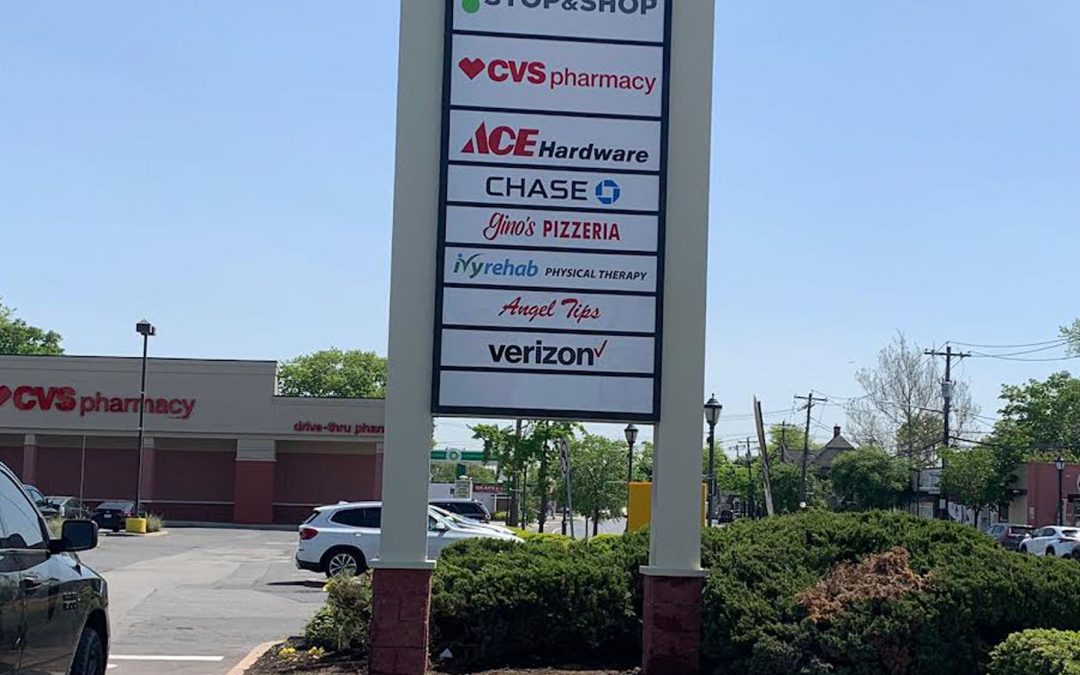
They come in a range of sizes and styles — single-tenant signs for one business, multi-tenant signs that list every occupant in a complex, static illuminated cabinets, and electronic message centers (EMCs) that can display changing text and graphics.

The Part Nobody Warns You About: Permits
Here's the reality that catches a lot of business owners off guard — pylon signs almost always require a permit, and on Long Island, that process can be genuinely complicated.
Nassau County and Suffolk County are made up of dozens of individual municipalities, and the rules in Babylon are not the same as the rules in Huntington, Islip, or Oyster Bay. Height restrictions, setback requirements, sign area calculations, and illumination rules all vary town by town. Some towns have straightforward applications with predictable timelines. Others require site plan approval, architectural review, or a variance — which adds weeks or months to the process.
A lot of sign companies will sell you a sign and hand the permit application back to you to figure out yourself. That's not how we work. Valle Signs handles the permit process in-house — we prepare the drawings, submit the application, and follow up with the town so you don't have to become an expert in local sign ordinances.
For projects in New York City — Brooklyn, Queens, Manhattan, the Bronx, Staten Island — we hold the NYC Special Sign Hanger License, which is a requirement for commercial sign installation in the five boroughs. Most Long Island sign companies don't carry this license, which means they can't legally do NYC work. If you have locations on both sides of the border, we can handle both.
Pylon Sign Installation - The Full Process, Step by Step
Step 1 — Site Assessment
Every project starts with a visit to your location. This isn't just a formality — it's how we figure out the right sign size, pole height, and placement based on actual visibility from the road, where underground utilities run, and what the soil conditions look like for the foundation. A sign that looks great on paper can run into problems if there's a utility line exactly where the pole needs to go, or a grade change that affects sightlines from the street.
Step 2 — Design and Approval
Once we have the site information, our team puts together a rendering. You'll see exactly what the finished sign looks like before anything gets built — dimensions, colors, lighting, panel layout. We go back and forth until you're happy with it. This is the time to make changes, not after fabrication has started.
Step 3 — Engineering and Permit Submission
Pylon signs require structural engineering drawings, particularly for taller signs or sites in wind-exposure zones — which includes most of Long Island's South Shore and coastal areas. We coordinate with our engineers, prepare the full permit package, and submit it to the town. You don't have to manage any of this.
Step 4 — Fabrication
While the permit is in review, fabrication begins at our Copiague facility. We build in-house — the cabinet, the faces, the pole or poles, and all the internal wiring for illumination. As a UL-registered manufacturer, our electrical components meet the safety standards required for commercial sign permits, which matters when the town inspector comes out.
Step 5 — Installation
Once the permit is approved and the sign is built, we schedule the installation. Depending on the sign, this involves a crane or boom truck, a concrete foundation pour, and an electrical connection for illuminated signs. For most standard pylon signs, the physical installation takes one to two days.
Step 6 — Final Inspection
Most towns require a sign inspection after installation before the sign is officially approved. We handle the scheduling and make sure everything is in order for the inspector. Once you have your sign-off, you're done.

How Long Does the Whole Thing Take?
The honest answer is that the timeline depends almost entirely on how fast the town moves on your permit application. Once a permit is approved, fabrication and installation typically run four to six weeks.
The permit itself is the variable:
- Straightforward applications in cooperative towns: three to six weeks
- More complex projects requiring variances or additional review: two to four months or more
- NYC projects with DOB involvement: timelines vary significantly by borough and scope
All in, the typical timeline from initial consultation to a finished, inspected sign is three to five months. If you're working toward a specific date — a grand opening, a lease start, a renovation completion — tell us upfront and we'll give you an honest picture of what's achievable.
Common Questions We Hear
"I don't know which towns allow what." Neither do most business owners — and you shouldn't have to. We research the specific requirements for your location before we finalize any design so there are no surprises mid-process.
"My last sign company disappeared after they took the deposit." Valle Signs has been serving Long Island businesses for decades, and we have the reviews to back it up. You'll work with a named project contact from start to finish — not a revolving door of reps.
"I got a much cheaper quote from someone else." Cheaper usually means shortcuts on engineering, permits skipped entirely, or materials that won't hold up to Long Island winters and coastal humidity. A sign that fails inspection or needs replacing in a few years costs more than doing it right the first time.
"I don't want to deal with the town." You won't have to. We handle permit submissions, follow-ups, and inspection scheduling. Most of our clients never set foot in a permit office.
Ready to Get Started?
The best first step is a quick conversation about your location, your timeline, and what you have in mind. We'll schedule a site visit, put together a design and quote, and walk you through exactly what the permit process looks like for your specific town.
Call us at (516) 408-3440 or contact us online to get started.
55 Decker St, Copiague, NY 11726
Frequently Asked Questions
Do I need a permit for a pylon sign on Long Island?
Yes — almost all pylon signs require a permit, and the specific requirements depend on which town or municipality your property is in. Nassau County and Suffolk County each have dozens of separate jurisdictions with their own sign ordinances covering height, setback, square footage, and illumination. Valle Signs handles the permit process in-house so you don't have to navigate this on your own.
How long does pylon sign installation take on Long Island?
From first consultation to a finished, inspected sign, most pylon sign projects take three to five months. Fabrication and installation typically run four to six weeks once the permit is approved — the permit process itself is usually the longest part of the timeline, ranging from a few weeks in simpler towns to several months in jurisdictions with more complex review processes.
Who handles the permits for a pylon sign?
Valle Signs manages the entire permit process in-house — engineering drawings, permit application, town submission, and follow-up. You don't need to visit the permit office or track down zoning requirements yourself. For NYC projects, we also carry the NYC Special Sign Hanger License required for commercial sign installation in the five boroughs.
How much does pylon sign installation cost on Long Island?
Pylon sign pricing depends on size, whether the sign is illuminated, single or multi-tenant, and the complexity of the foundation and electrical work. Permit fees are charged separately and vary by town. We cover pricing in detail in our pylon sign cost guide.
What type of foundation does a pylon sign need?
Most pylon signs are set in a reinforced concrete foundation. The depth and diameter depend on the sign's height, weight, and wind-load requirements — all calculated by our engineers as part of the structural drawings prepared for your permit application. Long Island's coastal and South Shore areas often have specific wind-load requirements that affect foundation specs.
Can I install a pylon sign if my property has underground utilities?
Possibly, but it needs to be checked before any digging begins. Our site assessment includes reviewing utility locations so we can plan pole placement accordingly. In most cases it isn't a problem, but it's important to confirm before the project moves forward.
Do you install pylon signs in New York City as well as Long Island?
Yes. Valle Signs holds the NYC Special Sign Hanger License, which is required for commercial sign installation in all five boroughs. Many Long Island sign companies can't legally do NYC work — we can, which makes us a practical option for businesses with locations on both sides of the city line.
What happens if my town denies the sign permit?
It doesn't happen often when applications are prepared correctly, but if a town requires a variance or raises an objection, we work through the process with you. That might mean adjusting the sign dimensions to meet code, presenting at a zoning board meeting, or exploring alternative designs. We let you know what's involved before you decide how to proceed.
Can an existing pylon sign be repaired or updated instead of replaced?
Often yes. If the structure is sound, we can reface the panels, upgrade the lighting to LED, or replace a cabinet face without building a new sign from scratch. If the sign is damaged, outdated, or structurally compromised, a full replacement may make more long-term sense. We can assess your existing sign and give you an honest recommendation.
How do I choose between a single-tenant and multi-tenant pylon sign?
A single-tenant sign makes sense if you own or occupy the property exclusively. A multi-tenant sign — with separate panels for each occupant — is typically used in shopping centers, office parks, or multi-unit commercial properties where visibility for all tenants matters. Property managers and landlords often include pylon sign rights in leases, so it's worth checking your lease terms before making a decision.